
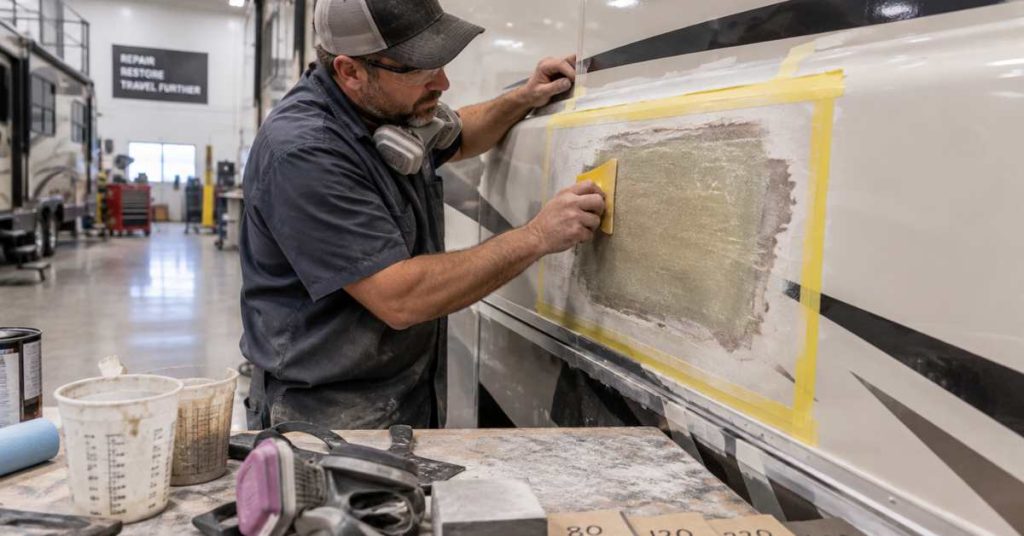
A crack on an RV may seem like any other body damage.
But that is rarely the case.
Motorhomes, fifth wheels, travel trailers, and campers use a very different construction style compared to ordinary cars and trucks.
Large fiberglass panels may connect to laminated walls, framing, roof sections, slide-outs, windows, and other coach components.
For that reason, fiberglass repair in an RV requires special techniques.
RV Fiberglass Is Different From Automotive Steel Panels
Car body specialists work mostly with steel panels, aluminum body parts, plastic bumpers, and other body materials.
RV construction differs from ordinary car bodies.
Many recreational vehicles feature large fiberglass or composite panels on the exterior.
Such panels may serve as a part of a laminated wall system, which differs a lot from the car-type body construction.
For that reason, repair in the RV requires different technique.
A repair specialist may need to deal with:
- Fiberglass cloth or mat
- Resins
- Gelcoat
- Fillers
- Adhesives
- Laminated wall materials
- Sealants
- Primers
- Automotive-type paint system
- Clear coat
RV Fiberglass Repair Is Not Just About Filling Cracks
A crack in a RV body looks similar to an automotive damage.
Yet it is not as simple as it seems.
Not all exterior damages are only cosmetic.
Exterior damage may hide deeper problem, which should be revealed by a skilled RV repair technician.
That is the reason professional RV body shops apply special repair techniques for each particular vehicle.
Fiberglass Crack Should Be Treated Differently
You may be tempted to fill a crack with body filler.
But such technique will never produce proper results.
To repair a fiberglass damage, you need to treat the damaged area first.
Technician may need to clean, rough and open the damaged area.
Layers of special fiberglass and resin will reconstruct the damaged panel.
Once curing is complete, the area is shaped and sanded.
Collision Damage Can Require Fiberglass Reconstruction
Collisions often lead to not only minor cracks but also significant damage to body sections and fiberglass panels.
To repair damaged section, a technician may need to rebuild it completely.
And that requires much more skills than application of body filler.
The damaged section needs to acquire necessary contours to be able to mount doors, lights, trim and graphics.
Professional fiberglass reconstruction may be able to repair the panel that would need to be replaced otherwise.
Gelcoat Damage Needs a Different Technique
Not all surfaces of RV use fiberglass panels.
Some coaches may feature gelcoat finish.
Gelcoat is popular in fiberglass manufacturing because of its smooth finish and protective properties.
Over time gelcoat finish may oxidize, fade or get impact damage.
And it needs special technique for repair.
Gelcoat repair requires sanding, filling, finishing and color matching.
Delamination is a Serious Problem
Delamination may be another reason to use special fiberglass repair techniques.
Delamination is the situation, when layers of the laminated wall begin separating.
You may notice bubbles, waves of the sidewall, bulging fiberglass, soft spots or large loose areas.
Moisture is usually the reason of delamination.
It may have entered from roof seam, a window, a light, a slide-out, a cracked sealant or damaged fiberglass.
Just trying to push fiberglass into place will not help you solve the problem.
A repair specialist should establish why the wall is separating before making repair.
Water Damage Is Another Serious Problem
Water is one of the most destructive things that can happen to an RV.
It does not need a large opening to travel behind the exterior panels, creating invisible problem.
Over time moisture may damage wood, insulation, adhesives and flooring.
That is why fiberglass repair sometimes leads to water damage repair.
Before refinish of the exterior panel, a shop needs to remove the damaged material, repair the source of leak, dry the area and rebuild the affected section.
Otherwise, you will just hide the problem under the new layer of coating.
Perfectly Sanded Fiberglass Repair Looks Invisible
A strong repair is crucial.
But the repair should not be visible.
RV sides usually have large, smooth areas.
Even a tiny high or low point will be visible after glossy paint.
Professional body specialists spend time on sanding and fairing the repaired area.
And the process may need to be repeated several times to achieve perfect result.
The goal is to create a seamless transition between the repaired area and original panels.
A good repair work should not look like a fiberglass patch on the side of the RV.
Proper Color Matching Is Crucial for Fiberglass Repair
After fiberglass repair, the shop needs to paint the RV.
That is especially hard for coaches that have spent years under Arizona sun.
Original paint color may fade.
Several colors may be used in graphics.
Metallic and pearl colors vary depending on the viewing angle.
To match such paint job, professional RV body shop uses paint-matching equipment.
After that, the technician blends the repair into adjacent panels.
That way a visible line between original paint and the repair can be avoided.
Professional RV Body Shop Should Be Large Enough
Repainting a motorhome is significantly different from repainting a regular car.
Its size alone creates certain challenges.
A professional RV body shop should have enough space to properly prepare, mask, paint and cure large coach sections.
RV Renovators has a full-service body shop facility with 55-foot paint booth and dedicated fiberglass repair capabilities.
That way fiberglass repair and refinishing can be done in the same location, without sending separate jobs to different facilities.
RV Collision Damage Can Affect Multiple Parts of the Vehicle
If a collision happens, multiple systems of the RV may be affected.
For example, a collision near the sidewall may cause damage to:
- Fiberglass panels
- Aluminum or steel framing
- Storage compartments
- Doors
- Slide-outs
- Roof transitions
- Lights
- Trim
- Electrical components
- Paint and graphics
Fiberglass may be just the visible component.
That is why professional RV body shop takes into consideration interaction of various components of the RV body.
Simple restoration of appearance will not give you good results.
RV Roof And Sidewall Are Closely Connected
Roof and sidewalls of an RV are connected by certain seams and transitions.
Any damage near that area needs special attention.
Collision, fallen tree, storm or roof leak may damage both roof and sidewalls.
If a fiberglass repair is done near the roofline, the shop should carefully inspect the nearby areas.
That way it is impossible to fix one part of the damaged RV without allowing water to enter from the roof seam.
And this is the reason why RV-specific repair experience is important.
Slide-Out Damage Needs Careful Inspection
Slide-out mechanism requires careful attention during collision repair.
Slide-out moves and that means that several components need to work perfectly together.
Collision in a slide-out area may require not just the repair of the fiberglass, but also careful inspection of other components.
A slide-out that looks repaired but does not work properly may create much larger problem for the owner.
Home Fixings Of RV Fiberglass Damages Can Lead To Further Problems
Fiberglass repair kits are easily available on the market.
But it does not mean that every home fix will produce a professional result.
Cosmetic repair looks easy enough.
But improper resin, filler, adhesive or repair technique may cause problems.
Improperly applied fiberglass patch can cause distortion of the area.
Poor bonding may allow crack to come back.
If the moisture is trapped inside, it can continue damaging the wall.
In addition, home fiberglass repair may need to be removed before repair specialist starts his work.
If the damage was caused by a collision, try to document the damage.
Insurance Repairs Require Good Documentation
RV collision damage or storm damage may be the subject of insurance claim.
Insurance coverage depends on your policy and the type of the damage.
Professional RV repair shop can inspect the damage, provide you with an estimate, document additional repair works and talk to insurance company if needed.
Sometimes additional damages become evident during the repair process.
That may require supplemental estimate.
Using the services of the shop that specializes in RV insurance repair can be helpful for the owner.
Why RV Fiberglass Repair Should Be Performed By Experienced Specialist
Fiberglass repair is partly the issue of materials.
But experience in the RV repair is even more important.
Experienced technician knows typical locations of possible leaks, properties of laminated wall, locations of the framing and connection of slide-outs and roof sections.
All that information helps to define if the problem is cosmetic or if there is something deeper inside.
RV Renovators is specialized in recreational vehicle repair.
Our full-service RV repair facility in Mesa, Arizona is capable of handling collision repair, fiberglass reconstruction, paint, gelcoat repair, delamination, water damage, roof repair, slide-out work and other repairs.
Have Your RV Fiberglass Damages Checked Before They Become Bigger
Fiberglass damage can be easily overlooked.
It is not leaking.
The coach still drives.
You see only the surface of the problem.
But vibration, Arizona sun, rain and water intrusion can turn small fiberglass problem into big one.
Cracks, bubbling, delamination, collision damage, peeling paint, gelcoat damage or soft exterior wall should be inspected.
RV Renovators can provide professional RV fiberglass repair from our full-service facility in Mesa, Arizona, just outside Phoenix.
The team of professionals with decades of experience in RV repair work on motorhomes, fifth wheels, travel trailers, campers and other recreational vehicles.
Fiberglass repair should not be just a cover-up of the crack.